CFBDepth sold fans, bettors, and subscribers limited access to college football data sheets stripped of their proprietary formulas, and its staff couldn't build every view those users wanted. In about 8 weeks, racing the start of the college football season, I led the project and designed CFBAI, an AI chat agent that lets users ask for the data in plain English: I designed the conversation and the agent's personality, built the chat experience, and gave the agent a memory of each user's teams, data preferences, and betting factors. Alongside it, a data-licensing API added a new kind of customer, the API buyer, and I designed the internal tool that issues and rotates their keys. Both launched before Week 0, bringing in new users at higher price points and a new revenue stream, with a handful of API customers before we handed off the final API tool.
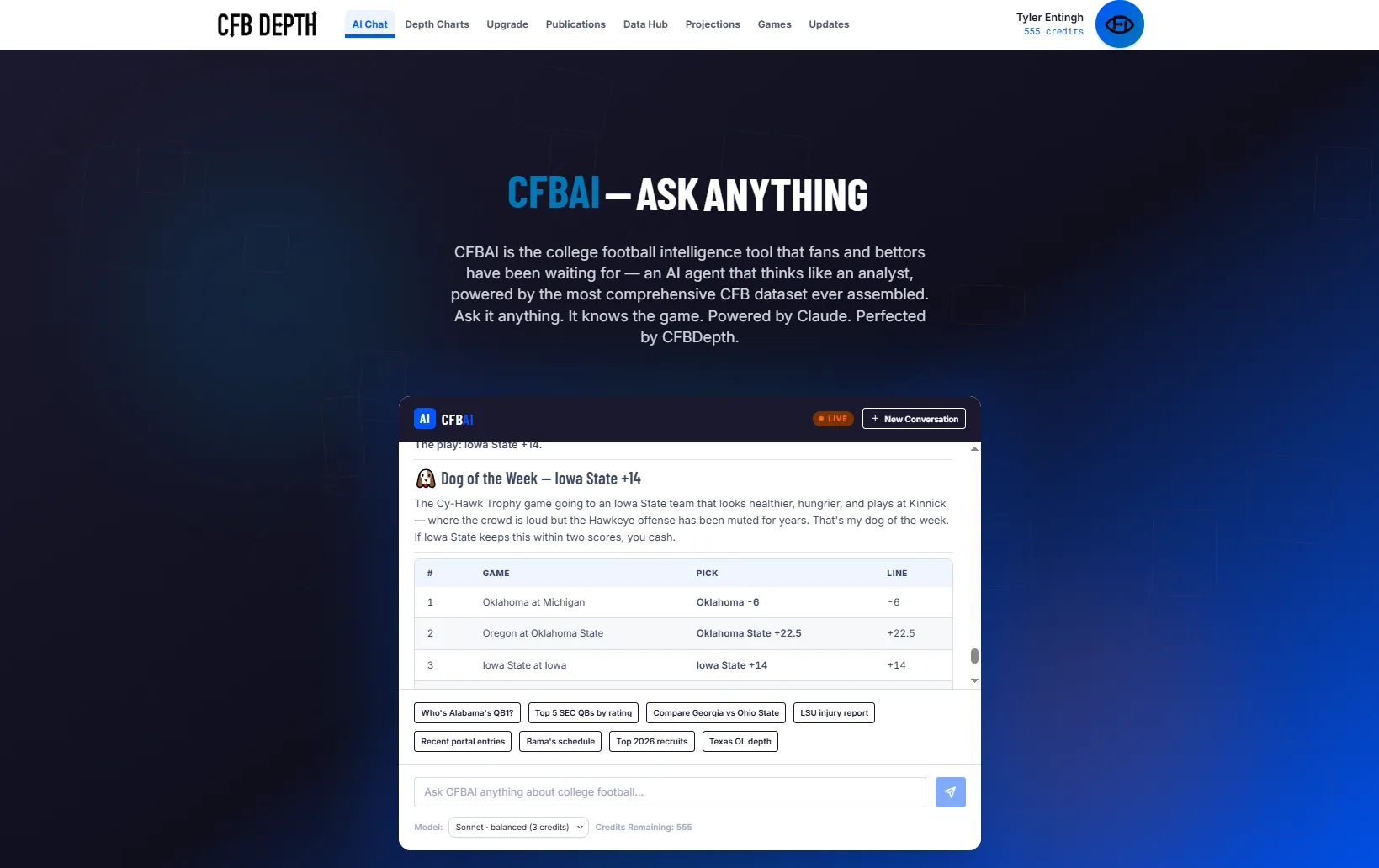
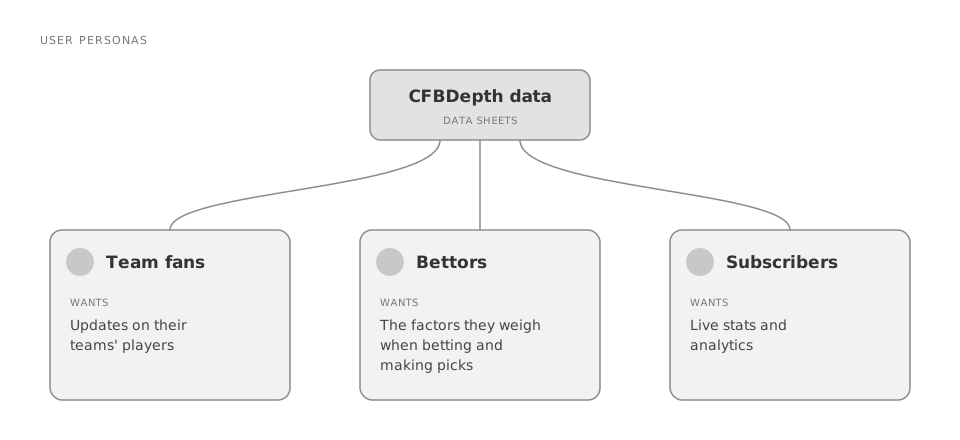
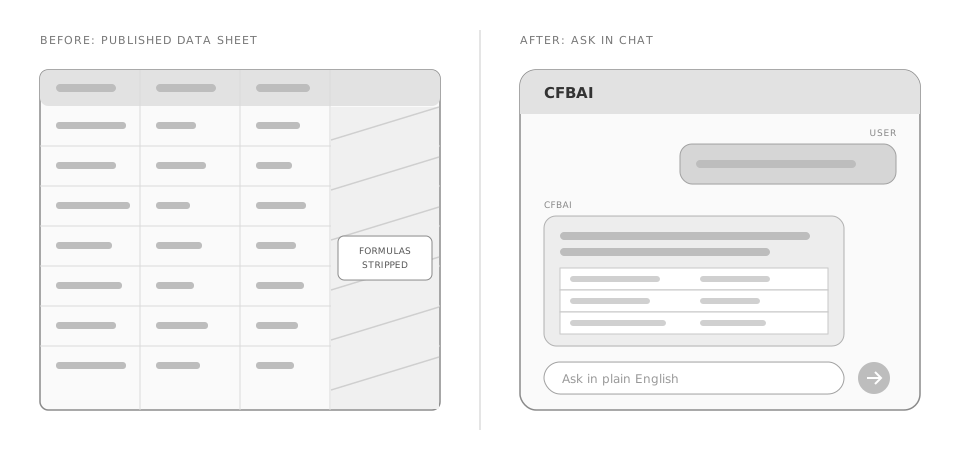
CFBDepth.com published college football data sheets: live stats and analytics. Users paid for limited access to those sheets, which were stripped of CFBDepth's proprietary formulas before publishing. Those users were fans who wanted updates on their teams' players, bettors, and subscribers.
Using the data the way they wanted was a heavy lift. Each user wanted to slice the data differently, and CFBDepth's staff couldn't build all the views it would take to satisfy them.
The owner of CFBDepth asked for the project. The deadline was fixed: everything had to be complete before Week 0 of the college football season, because CFBDepth's primary audience, gamblers, would want the tool as soon as games kicked off.
I was Project Lead & Senior Designer on a team with 2 engineers. I built the agent's chat experience and designed its conversations, and I did some engineering on the agent itself as part of quality assurance. The engineers set up the database and built the API tooling.
We started by meeting with CFBDepth's stakeholders and users to identify every user persona: the value each one got from CFBDepth, how they used it, and their goals and motivations. That research fed the conversation design.
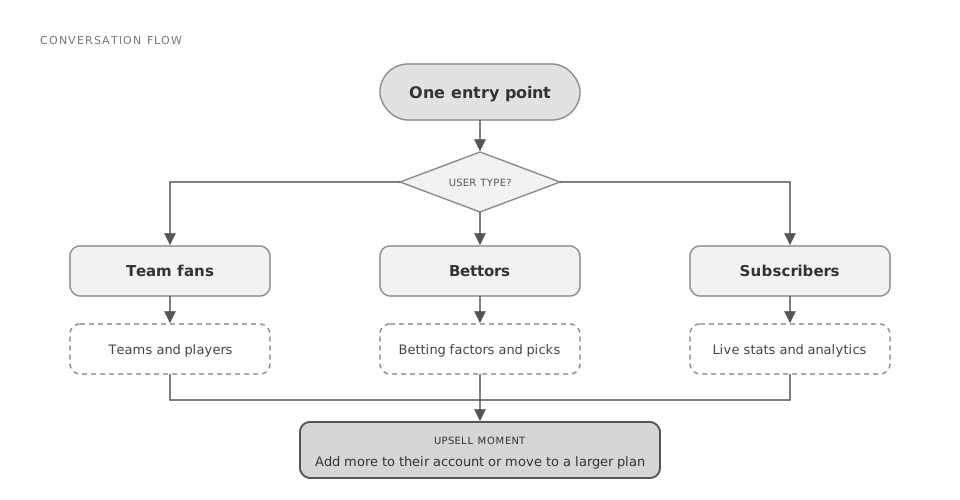
Next came the agent's personality. We modeled it on head football coach Nick Saban: authoritative, confident, and not afraid to let its opinions be known. Then we architected how conversations should flow, so that every user type got to what interested them most. A model picker in CFBAI let users choose different AI models depending on the type of information they wanted.
From there, we built payment into both the tool and the conversation itself. CFBAI runs on a credits system, and we designed how the agent would prompt users to add more to their account or move to a larger plan.
Then we built the API tool, an internal tool for issuing API keys to clients (see Decision 03). I designed its UI with Claude Code. Because it was a simple internal tool, we tested it only through internal usability testing.
We wrote training materials for both the chat agent and the API tool. A final UI pass brought in CFBDepth's new branding so the agent felt like part of one cohesive experience.
Figma was for design, Vercel for hosting, Railway for the database, and Docusaurus for documentation.
A conversation instead of more data views
I put CFBDepth's data behind an AI chat agent, so users could ask for what they wanted in plain English.
Considered instead: what CFBDepth was already doing, having staff build more views of the published sheets.
The spectrum of needs and users was too wide for pre-built views to cover. And more and more users are comfortable with language models, so a chat experience gave the brand a modern feel. It took pressure off CFBDepth's staff and let users work with the data directly.
An agent that remembers, at the cost of an extra call every session
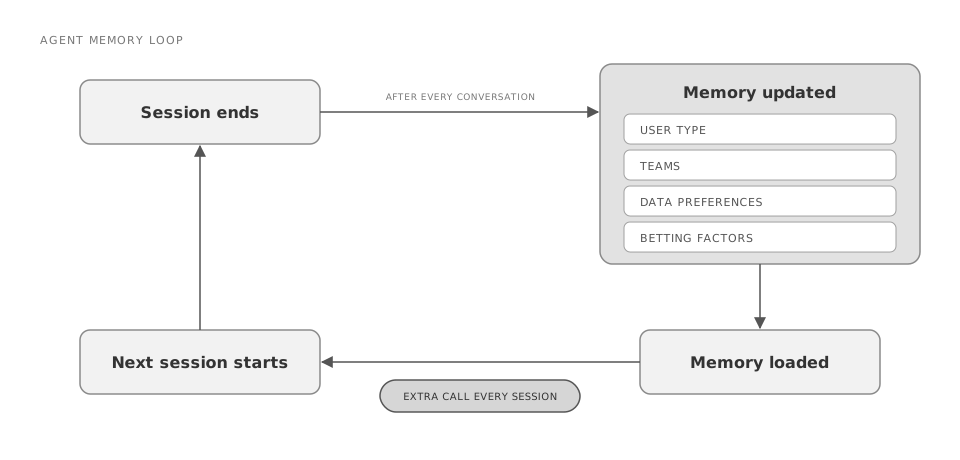
I designed the agent to remember each user: their user type, the teams they support and why, the data they like to examine and how, and the factors they weigh when betting and making picks. After every conversation, the agent updated its memory, and it read that memory back in before starting the next session.
Considered instead: a simpler agent without memory.
Memory made the solution more complex, and the extra call it added to every session made it much more expensive to run. We accepted both, because a better experience was the priority for capturing users.
A licensing API the original scope didn't include
The original scope covered only the chat agent. During a weekly check-in, the owner and I talked about who else would want CFBDepth's data and how it could be monetized, and every option led back to distributing API keys.
Considered instead: keeping the data inside CFBDepth's own site and the chat agent, as the original scope did.
An API brought in a new type of user, the API buyer, as part of CFBDepth's push to grow the brand. We ran it as a separate statement of work (SOW) alongside the chat agent, inside the same pre-season timeline.
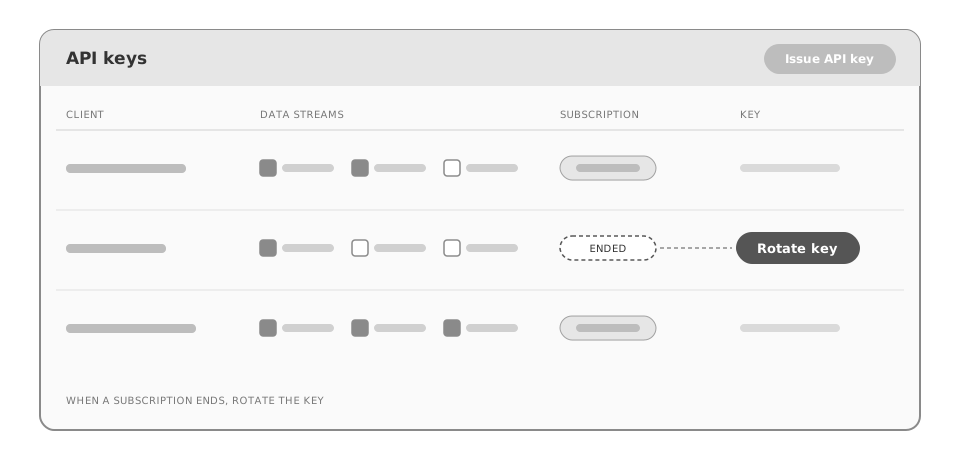
The 2 engineers built the API tooling; I designed the UX/UI of the internal tool that generates clients' API keys. It puts front and center which data streams each client gets, and how to rotate keys when a subscription ends.
"The API opened a new revenue stream."
The chat agent and the API tool both launched before Week 0, ahead of the season deadline. The chat agent let users pair CFBDepth's many-layered data with the power of AI, and it became the backbone of CFBDepth's initiative to scale up and offer more to its users. It brought in new users at higher price points, and the API opened a new revenue stream: CFBDepth already had a handful of API customers before we handed off the final API tool.
There's no hard metric.